 Tolbek
Home Valley: rules of play
A cooperative game for 1 to 5 players. There are 3 to 5 characters in play, and each player controls one or more of them.
How to read the rules. Chapters 0 to 10 are enough for your first game. Chapter 11 adds variants when you want more. Chapter 12 tells the story of the five expeditions. At the end is an Overview you can check at any time during play.
0. The game in brief
Home Valley is an ordinary valley with one village. In the middle is the village green with an old linden tree and a brook; around it a farm, a mill, a timber yard and a school, and a chapel on the hill. East of the village runs the river, crossed at the ford, and beyond it lie the meadows where the fog settles in autumn. West are the pastures and the hill cottages; north the forester’s lodge, the old cable car and the mountain pass; south the old mine.
When something goes wrong in the valley, help from outside is a long way off, so nobody waits for it. Four neighbours set out. Betty drives the Badger, an old off-roader with two seats and a back full of tools. Matt fixes whatever is broken. Maggie delivers the post and knows every house and every path. Agnes looks after anyone who needs it. And with five players, Percy the mayor joins in: when he says the village is going to help, the whole village turns out.
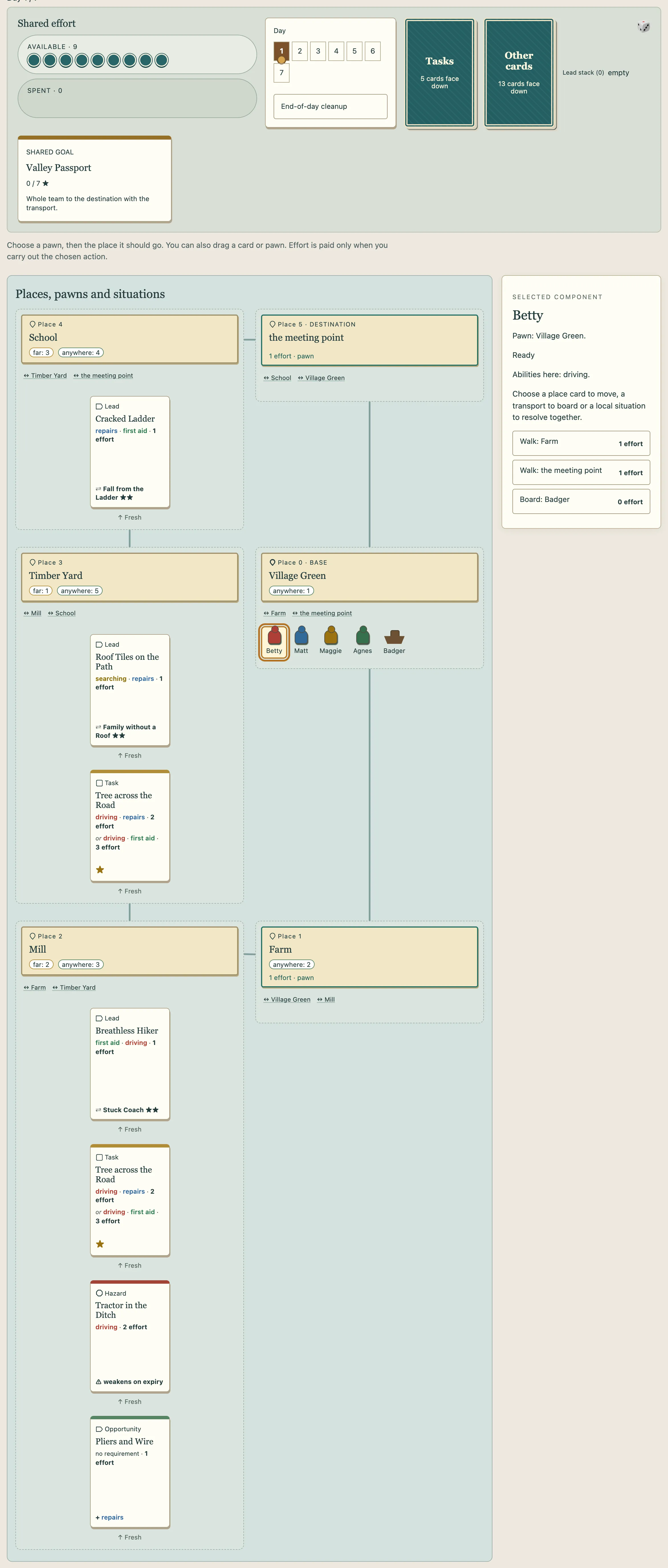
For every task you complete, the team gets as many passport stamps ★ as the card shows, in the Valley Passport. An expedition succeeds when the passport holds enough stamps and the whole team is at the meeting point, with the Badger whenever the expedition has it. Then the whole team signs the Village Book, where the village keeps what happened and when: write the date in the expedition’s space in the passport.
Everyone at the table plays together: either you all win, or nobody does.
The game is played over several days, and the day marker shows which day it is. Each day goes like this:
- Agree on what you will do.
- Spend effort on actions: walk, ride the Badger, solve cards.
- Clean up the table and start the next day.
The expedition succeeds when you have collected enough stamps ★ from tasks and the team reaches the meeting point. It fails when the last day ends before you have signed the Village Book.
1. Goal of the game
An expedition succeeds when all of this is true at once:
- you have the required number of stamps ★ from solved tasks,
- all characters stand at the meeting point,
- the Badger is there too, when the expedition has it.
Expeditions 3 and 5 have no Badger, so only the people need to get there.
The expedition card tells you how many stamps you need and where the meeting point is. Once all of this is true, take the action Sign the Village Book, and you have won.
If the last day ends and you have not signed yet, the expedition has failed.
2. What is in the game
| Component | How many | What it is for |
|---|---|---|
| expedition card | 1 | the passport: how many stamps, the meeting point, the story, days and effort |
| scenario card | 1 | number of days and effort; spaces for the days |
| place cards | 6 | a slice of the valley for one expedition; each shows its routes and die numbers |
| character cards | 4 (+1) | Betty (driver), Matt (handyman), Maggie (postwoman), Agnes (doctor); Percy (mayor) for a fifth player |
| Badger card | 1 | seats in the cab and its range; in expedition 3 the cable car takes its place, in expedition 5 there is none |
| situation cards | 25 | 7 tasks, 15 others (one of them an instant card ⚡) and 3 two-sided leads |
| special cards | 1 or 2 | Footbridge Fund, Village Meeting, Sandbags, Rope, Last Can of Petrol |
| pawns | 5 (+1) | one for each character and one for the Badger |
| effort tokens | 13 | the effort of a day (8 to 10), shared or on the character cards depending on the expedition; the rest go on the Footbridge Fund circles or mark the Helping hand |
| day marker | 1 | shows which day it is |
| die | 1 | decides where a new card goes |
The frame shape around a picture tells the kind of card: a rounded square is a task, a tag is an item, a shield is protection, an arrow is a lead, an octagon is a hazard. Places have a map pin, characters a circle and the Badger an oval.
Situation card
Read it from top to bottom:
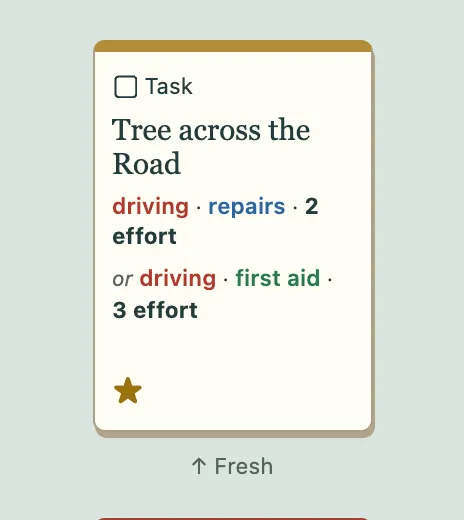
- Kind: task, opportunity, lead or hazard.
- Name.
- One or two rows. Each row says which abilities you need and how much effort it costs.
- Result: stamps ★, an item, ⇄ turning a lead over, or a hazard.
- Orientation: a fresh card stands upright, an urgent one lies on its side.
Situation cards have two different backs: task and other. Leads are two-sided: their other side is a task.
The expedition card and the Valley Passport
The expedition card is also the Valley Passport. Put solved tasks next to it. Stamps ★ are counted here.
On the expedition card you find:
- the number and difficulty of the expedition (three dots),
- its name and story,
- the goal sentence: how many stamps you need and where the meeting point is,
- the number of days and the effort,
- what starts on the table and which special cards are shuffled in,
- special rules of the expedition, each in one sentence.
The lid of the box shows the passport with five spaces for the five expeditions. Sign a successful expedition into the Village Book: write the date in its space.
Expedition numbers and adding other cards
Cards made for a particular expedition carry its number in the corner, for example ②. Some carry several, for example ②④. A card without a number belongs to the base game and is used in every expedition.
Shuffle in only the cards that the expedition card lists. The expedition was tuned with those.
You can add a favourite card to another expedition too. The expedition will then play differently from how we tuned it. It may be easier or harder.
3. Setup
- Lay out the place cards so that their printed routes join up. The first place is the Village Green, where you set out from. The last is the meeting point. Put the expedition card (the passport) beside them.
- Each player takes a character card and its pawn. Place the card with its family side up: the side without an advantage (the advanced side is in chapter 11.2).
- If there are fewer players than characters, some players control more than one character.
- Put all pawns at the Village Green. Put the Badger there too. In expedition 3 the cable car stands at the Bottom Station. In expedition 5 there is no vehicle.
- Lay out the scenario card and put the day marker on space 1.
- Put as many effort tokens in the middle as the expedition card says. In expeditions 2 and 4 the player on morning duty shares them out once the cards of step 10 are on the table (chapter 4.2).
- Cards that start in play go where the expedition card says, for example the Sandbags beside Betty’s card.
- Sort the situation cards by their backs. Shuffle the task cards and the other cards separately. Add any special cards that the expedition card lists.
- Take the 3 leads. For each one, roll the die and put the lead, lead side up, at the place that shows the rolled number in the “far” colour (chapter 6.4).
- Lay out 2 tasks and 2 other cards. The die decides where they go.
Who draws. The youngest player draws the cards and rolls the die at setup and on day 1. On each following day, the next player to the left takes over.
You can start.
4. How a day works
One day is one round of play. There are no turns. Characters act in any order and as often as you like, while you still have effort.
In the basic game effort is shared by the whole team. There are 8 tokens a day. Each action costs some tokens. Move the tokens you pay to one side.
The day ends when you all agree, usually when your effort runs out. Then comes cleanup (chapter 8). Unused effort does not carry over to the next day.
Tip: Say your plan out loud. In a cooperative game, talking things through is your strongest move.
In expeditions 2 and 4 effort works differently.
4.1 Pay your own way
In a flood or a storm, nobody knows where help will be needed tomorrow. So everyone has their own tokens: 10 a day in total, shared out between the characters.
- The tokens lie on the character cards.
- Whoever walks pays for the step.
- Whoever drives pays for the ride.
- When several characters do a job together, they pay between them. Each token comes from whichever of them has the most at that moment.
- Once a day a character may give one of their tokens to a friend at the same place.
Example: Maggie has 3 tokens and Matt has 2. Together they solve a card for 1 token. Maggie pays, because she has more. Then she gives one token to Matt, who stands beside her.
This stops one strong player from running the whole day for everyone: everybody gets a say.
4.2 Morning duty
Each morning the player who draws that day shares out all 10 tokens. Every character gets at least one. The tokens are shared out after the new cards are laid out, so the player on duty can already see the day’s work.
The next day the duty passes to the next player on the left, so everyone gets a go.
Example: There are four of you, and two tasks are waiting for Betty. The player on morning duty gives Betty 4 tokens and the other three characters 2 each.
4.3 Shared pool in expedition 2
If you want expedition 2 to be simpler, choose the Shared pool. You have 8 shared tokens a day, as in expedition 1. Advanced sides are then not played.
Both ways are balanced. Sharing out the tokens only stops one player from playing for everyone.
5. Actions
Each action shows how much effort it costs.
5.1 Walk (1 effort)
Move a pawn to a neighbouring place along one route.
Example: Matt stands at the Village Green. He pays 1 effort and walks to the Farm.
On the maps of the valley, not all routes are the same. A ↔ route is a road, for both characters and the Badger. A ⇢ route is a footpath for characters only. A ⇶ route is a ford or a cable-car line, which only the vehicle can use.
5.2 Solve a card (effort of the row)
You can solve a card at the place where it lies. Between them, the characters there must have all the abilities on one of its rows.
- Abilities of characters at the same place add up. A character in the cab may help too.
- Each helping character must bring at least one needed ability.
- You pay the effort once, for the row you completed.
- What the card gives is explained in chapter 6.
Example: Runaway Dog has two rows. First: searching + repairs for 2 effort. Second: searching + first aid for 3 effort. Maggie and Matt are both there. They pay 2 effort and the dog is home.
5.3 Items (free)
An item is a card a character carries. It gives one ability. Each character has 2 item slots.
With items you can, for free:
- give them to another character at the same place,
- drop them at a place and take them from a place.
Some items give no ability but protection ⛨ from one hazard (chapter 7.1).
Some items say “Discard:” and what happens then. Whoever carries one may discard it to the discard pile for free, then does what the card says. Old Alarm Clock: discard to turn one urgent task or lead back upright.
5.4 The Badger and the cable car
Boarding and leaving are free when the Badger is at your place. The card says how many fit in the cab: the Badger carries two.
Ride (1 effort). A character with driving in the cab moves the Badger up to as many routes as its range: up to 2, or up to 3 in expedition 2. Everyone in the cab travels with it. The driver pays for the ride. A ride in a damaged Badger costs 2 effort.
The Badger keeps to the road. It cannot reach the hill cottages. It can drive through a ford where nobody can wade.
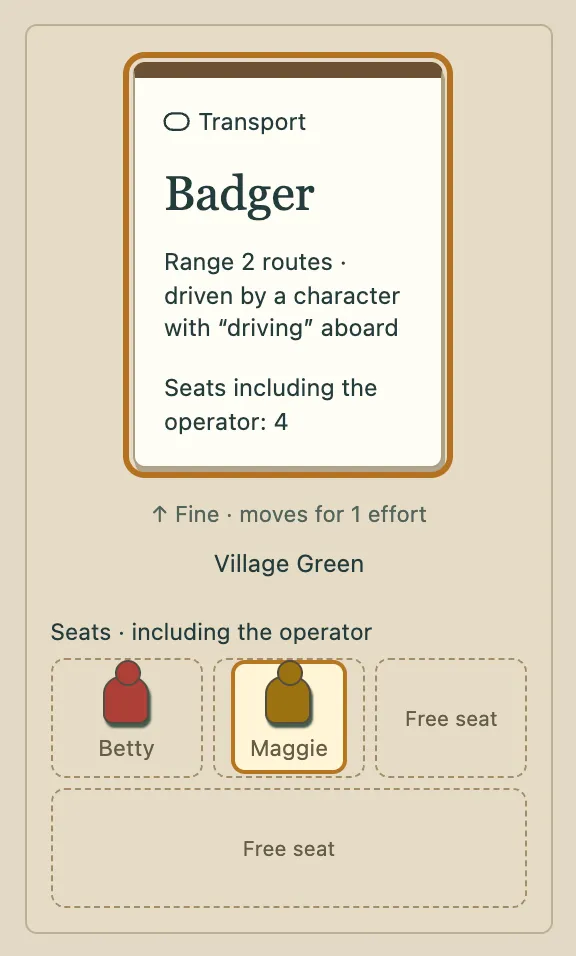
Example: Betty and Maggie board. Betty pays 1 effort and the Badger goes 2 places. At the new place both leave.
Cable car (expedition 3). The cabin starts at the Bottom Station. It runs only along its cable, between the Bottom Station and the Top Station; nobody can walk between them. It holds two. The lever is inside, so anyone sitting in the cabin can work it. It goes 1 route for 1 effort. A damaged cabin is repaired by Matt or by anyone with Pliers and Wire.
Example: Maggie and Agnes board at the Bottom Station. Maggie works the lever and pays 1 effort. At the Top Station both leave.
5.5 Recover (1 effort)
A character with first aid brings a weakened character at the same place back. A character with repairs mends the Badger or the cable car the same way.
5.6 Sign the Village Book (free)
When you meet the goal (chapter 1), choose this action. The expedition succeeded. Write the date in the space in the passport.
6. Situation cards
6.1 Two rows
Most cards have two rows. Completing one is enough.
- The first row is usually cheaper. It needs two characters with different abilities.
- The second row costs more effort, or asks for another pair.
- Which row you use is up to you.
6.2 What a card gives
Each card has one result:
- Stamps ★ (task). Put it next to the Valley Passport, the expedition card. Its stamps count towards the goal.
- Item (opportunity). One of the characters who solved the card takes it. It needs a free slot.
- ⇄ Turn over (lead). Turn the lead over where it lies. Its other side is a task with two stamps. It is fresh.
- Hazard. If you solve it, you avert it: discard it. If it expires before you solve it, it does harm (chapter 8). Some hazards leave an item that one of the solvers keeps. The Flu and Hornets in the Shed leave immunity: Linden Tea and Beekeeper’s Gloves. Beehives on the Road leave Beekeeper’s Veil, protection ⛨ from the hornets.
An instant card ⚡ is never placed. Whoever draws it reads it aloud. The team does what it says at once. Then it goes to the discard pile and the next card is drawn instead. Birthday: the die picks the guest of honour. Until the day ends, a card you solve together with the guest costs 1 effort less. The guest cannot give themselves the discount. A card always costs at least 1 effort.
6.3 How long a card lives
- A fresh card stands upright.
- At cleanup you turn it on its side. It is urgent.
- At the next cleanup an urgent card expires and goes to the discard pile.
So you have at most 2 days to solve a card.
An expired lead does not go to the discard pile. Put it lead side up under the lead stack. It will come back later.
6.4 Where a card goes
The place cards show die numbers in two colours:
- far: tasks and leads go here,
- anywhere: other cards go here.
Roll the die and put the card at the place that shows the rolled number in the right colour. If no place shows it, roll again.
6.5 Special cards
These five cards are shuffled in only for the expeditions that list them. The number in the corner shows which ones.
Footbridge Fund ①. This is a task. The collection tin goes round the village, so anyone can chip in, wherever they are. The row says Contribute: a character contributes by paying 1 effort and putting a token from the box on the circle of their colour. Each character contributes only once. When four circles are covered, the footbridge is paid for and you get its stamp. If only three characters are playing, all three must contribute.
Village Meeting ②④. This is a ⚡ card: the village decides what comes first. Choose together: A) turn one urgent task or lead back upright, or B) turn one lead over to its task side without solving it. First roll the die to see who has the casting vote. Count the characters clockwise, starting from the player who drew the card. Then talk it over. If you cannot agree, the player controlling that character decides.
Example: An urgent lead lies at the Farm. You roll the die and it lands on Maggie. You cannot agree, so Maggie’s player decides.
Sandbags ②. Betty starts the expedition carrying this item. Discard: move any hazard on the map, even a lasting one, to a neighbouring place where nobody is standing. You cannot move it to the meeting point.
Rope ③⑤. This item works every time and is never discarded. With the Rope, two walk as one: when a friend at the carrier’s place walks one step, the carrier goes along for free. The friend pays for the step.
Example: Matt carries the Rope and stands with Maggie at the Farm. Maggie walks to the Mill and pays 1 effort. Matt goes with her for free.
Last Can of Petrol ⑤. This item starts at the Village Green. Only one can of petrol is left in the garage: the Badger runs on diesel, but the old moped runs on petrol. Discard: the carrier moves up to two places for free. It works only once, and only the carrier travels.
7. States of characters and the Badger
The state is shown by turning the card of the character, the Badger or the cable car.
| Orientation | Character | Badger and cable car |
|---|---|---|
| ↑ upright | ready: everything works | fine: a ride costs 1 effort |
| → on its side | weakened: loses their own ability; items still work | damaged: a ride costs 2 effort |
There is no worse state. Recovery turns the card upright again (chapter 5.5).
7.1 Lasting hazards and protection
Some hazards say “Stays after expiring”. When such a hazard expires, it first weakens the characters at its place. Then turn it upside down and leave it there.
- Whoever enters its place is weakened.
- Whoever carries protection ⛨ from this hazard is safe.
- Protection also works when the hazard expires.
- You can solve a lasting hazard. That removes it.
Example: The Flu expires at the Farm and stays. Matt walks in and is weakened. Agnes carries the Jar of Honey, so nothing happens to her.
8. End of the day: cleanup
When you agree the day is over, do in order:
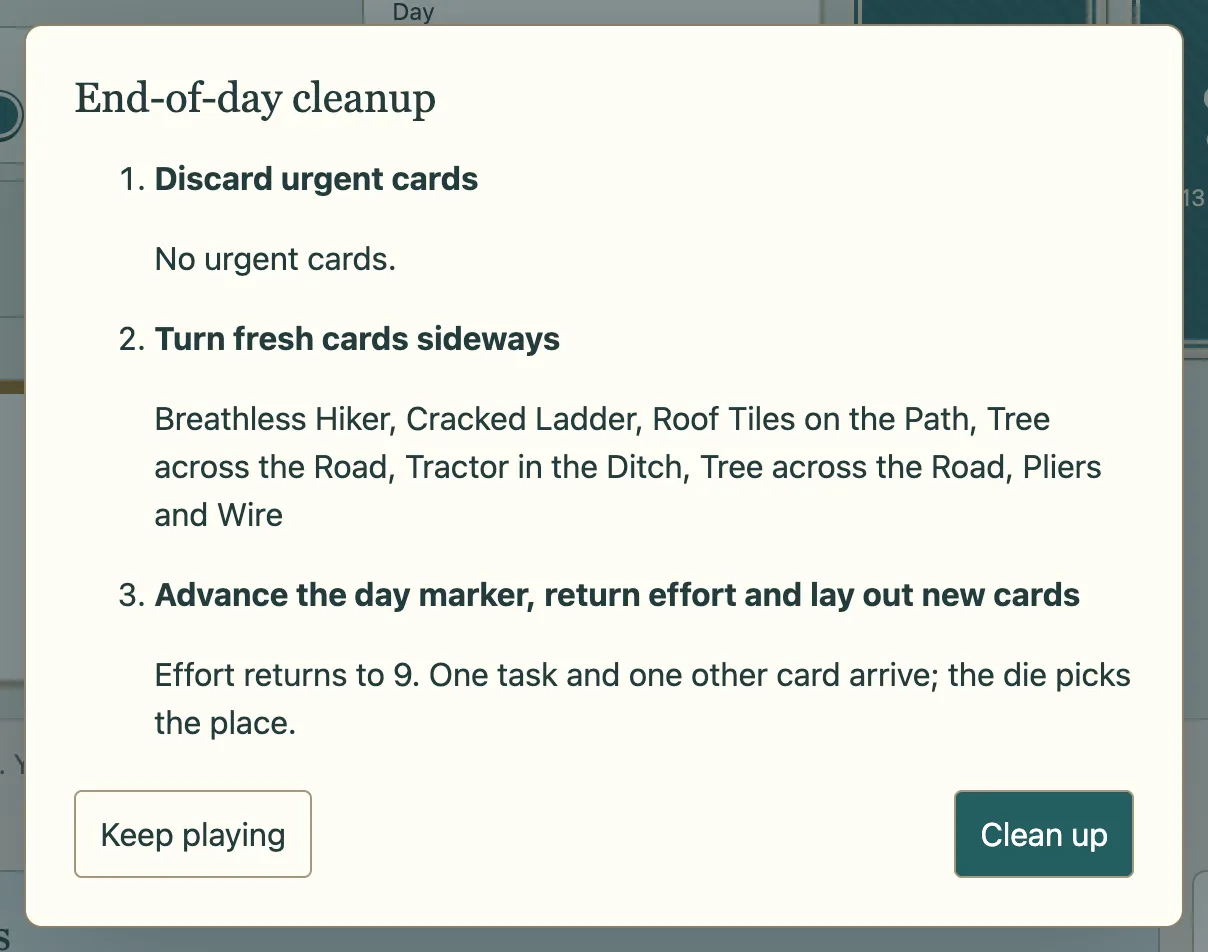
- Urgent cards expire. Put them on the discard pile. If it is a hazard, it weakens the characters without protection at its place. If the Badger or the cable car is there, it damages it too. Turn a lasting hazard upside down. Put a lead under the lead stack.
- Turn fresh cards on their side. Now they are urgent.
- Advance the day marker and take back all the effort tokens.
- Lay out 1 task and 1 other card. If the lead stack holds a card, lay out its top lead too. The die picks the place. Solve a ⚡ card at once.
- In expeditions 2 and 4 the player on morning duty now shares out the tokens, already seeing the new cards.
If the last day has just ended and you have not signed the Village Book, the expedition has failed.
9. End of the game
- Success: you met the goal and chose Sign the Village Book.
- Failure: the last day ended.
After the game, talk about what went well and what you would do differently next time.
10. Example of a day
It is day 1, you have 8 effort in the shared pool. The map holds 3 leads and these 4 cards:
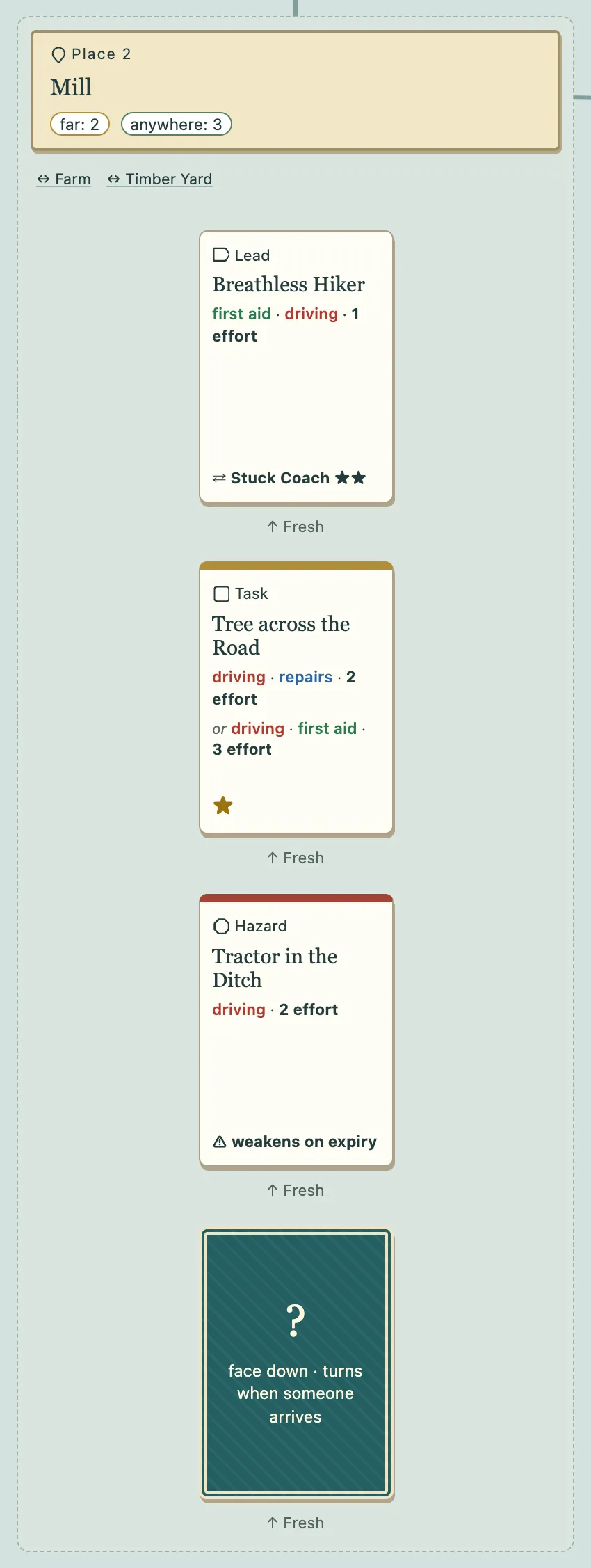
- Tree across the Road at the Mill,
- Tractor in the Ditch at the Farm,
- Pliers and Wire at the Village Green,
- Runaway Dog at the School.
The day could go like this:
- Maggie solves Pliers and Wire at the Village Green: −1 effort, 7 left. The pliers give repairs. Maggie keeps them.
- Maggie and Betty board the Badger (free). Betty rides to the Mill: −1, 6 left.
- At the Mill Betty and Maggie solve Tree across the Road with its first row: driving and repairs from the pliers. −2, 4 left. You have 1 stamp.
- Matt and Agnes stayed home. Nobody can reach the Tractor in the Ditch. The team agrees to end the day.
- Cleanup: nothing expires. The cards turn on their side. The day marker moves to day 2, effort returns to 8. 2 new cards arrive.
11. Variants
The scenario card or the expedition card switches variants on. You do not need to learn new rules for them: everything is printed on the cards.
11.1 Discovery
Items are laid out face down. The back shows only a question mark. You turn a card when any character arrives at its place. If someone already stands there, turn it at once. Tasks, leads and hazards always lie face up.
11.2 Advanced character sides
Turn the character cards to their advanced side. Each character has one advantage there:
- Betty: with the shared pool, the Badger goes one place further with her.
- Betty with tokens on the character cards has the Helping hand: once a day she gives one of her tokens to a character at a neighbouring place. She can give it even where the Badger cannot go. Betty drives all over the valley, so she knows who needs what.
- Matt: repairing the Badger or the cable car costs him no effort.
- Maggie: she may turn a face-down card at a neighbouring place for free (Turn a card, with Discovery or in fog). She knows every path blindfold.
- Agnes: recovering a character costs her no effort.
- Percy: he may give an item to a character at a neighbouring place.
Betty may use the Helping hand in addition to the ordinary once-a-day gift at the same place. When she uses it, put a spare token from the box on her card as a reminder, and take it off in the morning.
Example: Betty is at the Village Green with 3 tokens. Maggie is at the Farm with none. Betty uses her Helping hand and gives Maggie one token. The Farm is a neighbouring place, so Betty does not need the Badger.
In expeditions 2 and 4 we recommend advanced sides. Without them the Helping hand is missing. With them every character has an advantage.
11.3 Fog on places
Expedition 5 has fog at the River Meadows and at the Old Mine. An item that lands there while nobody stands there lies face down. Whoever arrives turns it face up. Tasks, leads and hazards stay visible: even in fog, you can hear people calling out about jobs and dangers.
Example: The Torch lands at the River Meadows. Nobody stands there, so it lies face down. When Maggie arrives, she turns it face up.
11.4 Point together
This is an optional rule of expedition 2. We are trying it out and it may stay.
In the morning everyone secretly picks a place for each of their characters. Then all point at once. Where two or more characters point, the first of them to walk in steps there for free.
This way everyone has their say before anyone can be outvoted.
Example: Maggie and Agnes both point at the Apple Orchard, Matt at the Farm. Two characters pointed at the orchard. Maggie walks there first and her step is free. Agnes pays for her step to the orchard as usual.
12. Scenarios, expeditions and difficulty
Each scenario has its own card. Difficulty changes only through stamps, effort and days.
| Scenario | Days | Effort | Stamps | Seats in the cab | Discovery | For whom |
|---|---|---|---|---|---|---|
| Introduction | 7 | 9 | 7 | 4 | no | first game, children |
| Split team | 6 | 8 | 8 | 2 | no | standard game |
| Team trial | 6 | 8 | 9 | 2 | no | experienced players |
| Hidden cards | 6 | 8 | 8 | 2 | yes | with discovery |
The stamp counts in the table are for the basic map. Your expedition has its exact count on the expedition card. That count is for Split team and Hidden cards. Introduction always needs one stamp fewer; Team trial always needs one stamp more.
The expeditions were tuned with Split team. Introduction is easier: play it as your first game in expedition 1, as its card says (the Badger seats four, seven days, 8 stamps instead of 9). Expeditions 2 and 4, where you pay your own way, are not played with Introduction; the app warns you if you try.
To make the game easier, add 1 effort or remove 1 stamp. To make it harder, do the opposite.
12.1 A year in the valley: five expeditions
The five expeditions follow the valley through a year, from one autumn to the next. Expeditions 1, 2 and 4 are in the base box; expeditions 3 and 5 are in the Snow and Fog expansion. Each one brings something new, and each gives you a little more to juggle at once.
| Expedition | Month | Stamps | Difficulty | What is new |
|---|---|---|---|---|
| 1 The New Footbridge | September | 9 | 1 | the Badger, Footbridge Fund |
| 2 High Water | November | 8 | 2 | Pay your own way, morning duty, Sandbags, Village Meeting |
| 3 Snow on the Pass | January | 7 | 2 | the cable car, Rope |
| 4 Summer Storm | June | 9 | 3 | a footpath the Badger cannot take |
| 5 Fog on the Meadows | October | 9 | 3 | fog, no vehicle, Last Can of Petrol |
1 · The New Footbridge (September). All summer, everyone crossed the brook by the footbridge on the green to get to the school, the chapel or the timber yard. Then the September rains came, the brook rose and swept the footbridge away. Now the village is cut in two. To reach the chapel or the timber yard you go round by the mill bridge, to reach the school you go through the shallows by the farm, and the Badger carries what people used to carry across by hand. The beams for the new footbridge are waiting at the timber yard, and in case there is not enough money for them, a collection tin is going round the village: anyone can chip in, wherever they are. And the footbridge has to be up before winter. Play your first expedition with the Introduction scenario: the Badger has room for all four, and you get an extra day.
2 · High Water (November). It rained for a week in November. The river has burst its banks across the meadows and flooded the orchard, and at the ford the water is waist-deep. The people across the river are cut off; the Badger can still drive through, because the water only comes up to its wheels. The meeting point is the narrow-gauge railway halt: its embankment is the only dry ground beyond the water, and from up there you can see the meadows and the orchard, so you know nobody has been left behind. Nobody knows where help will be needed tomorrow, so each morning everyone gets their own tokens to spend as they see fit. The player on duty shares them out, and the duty passes round the table. You can give a token only to someone standing with you; with the advanced sides, Betty can pass one to a neighbouring place. Betty starts with the sandbags: whoever carries them decides where they go, and a hazard is moved to a neighbouring place where nobody is standing. And when a Village Meeting is called in the middle of the work, the village decides what comes first.
3 · Snow on the Pass (January). In January, half a metre of snow fell overnight. The road to the pass is buried, the Badger stays in the garage, and up at the pass people are waiting for supplies. The only way up from the valley is the old cable car: a single cabin running between the Bottom Station and the Top Station. The lever is inside, so anyone sitting in the cabin can work it, and there is room for two. From the Top Station you go on foot, waist-deep in snow, past the radio mast on the ridge. Whoever finds the rope ties on to a friend: when the friend sets off on foot, the rope pulls the carrier along, so nobody gets left behind. The meeting point is the pass itself. The cable car does not go that far, and the people at the pass will take you back down on sledges.
4 · Summer Storm (June). The storm broke on a June afternoon and swept across the whole valley, from the chapel to the hill cottages. It left trees across the roads, telegraph poles down, the pastures under water and roof tiles all over the paths. The Badger cannot get up to the cottages, because only a footpath leads there; everywhere else it can drive. The storm scatters the team across the valley, and wherever you end up, you pay your own way: each character has their own tokens for the day, and each morning the player on duty shares them out. With the advanced sides, Betty can lend a helping hand to a neighbouring place, even up at the cottages. And when a Village Meeting is called in the middle of the work, the village decides what comes first. The meeting point is the forester’s lodge, where the whole valley gathers after the storm.
5 · Fog on the Meadows (October). A year after the footbridge was swept away, fog has settled over the meadows and the old mine, so thick you cannot see a step in front of you. The diesel tanker never made it to the village, and the Badger is sitting with an empty tank. All that is left in the garage is one can of petrol, and the only thing that runs on petrol is the old moped, which Maggie will lend to anyone. Even in the fog you can hear people calling out about jobs and dangers, but anything lost in it only turns up when you get there. Everyone goes on foot; whoever has the rope ties on to a friend and goes along with them. The way to the chapel runs either across the meadows or past the mine, both deep in fog. The meeting point is the chapel, whose bell carries even through the fog. It is the last expedition of the year: no vehicle, thick fog, and only what you can carry.
13. Expansions
Expansions add only cards: new situations, leads, lasting hazards and protections, characters, places, expeditions and scenarios. They add no tokens and no rules. Whatever is new on a card, the card always explains itself.
Expeditions 3 and 5 are in the Snow and Fog expansion. It brings the cable car, the Rope and the Last Can of Petrol.
14. Overview
Actions
| Action | Effort | When |
|---|---|---|
| Walk | 1 | to a neighbouring place; not from the cab |
| Solve a card | effort of the row | your characters are at its place and between them complete one row |
| Give, Drop, Take | 0 | items at the same place |
| Board, Leave | 0 | Badger or cable car at the same place, a free seat |
| Ride | 1 (damaged 2) | a character with driving is in the cab (cable car: anyone aboard); range from the card |
| Recover | 1 | first aid brings a character back, repairs mend the Badger or the cable car |
| Turn a card | 0 | only Maggie’s advanced side, discovery and fog |
| Helping hand | 0 | only Betty’s advanced side with tokens on the character cards; once a day |
| Sign the Village Book | 0 | goal met |
| End the day | 0 | ends the day, any time you all agree |
Cleanup
- Urgent cards expire; a hazard weakens unprotected characters at its place and damages the Badger or the cable car there; a lead goes under the lead stack.
- Turn fresh cards on their side.
- Advance the day marker and take back the effort.
- Lay out 1 task, 1 other card and the top lead, if there is one; the die picks the place; solve a ⚡ card at once.
- In expeditions 2 and 4 the player on morning duty shares out the effort.
Often forgotten
- Effort does not carry over to the next day.
- In expeditions 2 and 4 everyone pays their own way: a token can only be given to a friend at the same place.
- Completing one row of a card is enough.
- A weakened character loses their own ability, but their items still work.
- Abilities in the cab count when solving.
- Turn a solved lead over where it lies. Tasks and leads go to the “far” places.
- Whoever enters a lasting hazard without protection is weakened.
- The Badger must reach the meeting point too, when the expedition has it.
- Shuffle in only the cards that the expedition card lists.
When in doubt
- Card text beats the rules.
- “Cannot” always applies.
- If a rule can be read two ways, choose the reading that is harder for you, and play on.
Glossary
| Term | Meaning |
|---|---|
| effort | tokens you pay actions with |
| day | a stretch of play from the start to cleanup |
| situation | a card at a place: task, opportunity, lead or hazard |
| task | a situation with stamps you need for a successful expedition |
| stamp ★ | a point in the passport for a completed task |
| Valley Passport | the expedition card; solved tasks are put next to it |
| Village Book | the village’s book; you sign a successful expedition into it |
| row | one way to solve a card |
| lead | a two-sided card; once solved you turn it over into a task |
| lead stack | leads lead side up next to the scenario card |
| lasting hazard | a hazard upside down that stayed after expiring |
| protection ⛨ | an item that protects from one hazard |
| immunity | protection that a lasting hazard leaves to one of its solvers |
| ability | driving, repairs, first aid, searching, persuasion |
| item | a card that gives a character one ability |
| Discard | an item you may discard for free to do what it says |
| ⚡ card | an instant card; solved and discarded at once |
| special cards | the five cards of the valley, shuffled in only for the expeditions that list them |
| morning duty | the job of sharing out the tokens each morning; it passes to the left every day |
| Helping hand | Betty’s advanced side: a token to a character at a neighbouring place |
| range | how many routes the Badger can go at most in one ride; printed on its card |
| fresh / urgent | a new card upright / an older card on its side |
| cleanup | the steps at the end of a day |
| Village Green | the place where you start |
| meeting point | where the team gathers at the end; the expedition card names it |
Appendix: for adults
How to explain the game to a child in 5 minutes
- Show the map and the meeting point: “We all have to get there together, with the Badger.”
- Show the effort tokens: “This is our energy for one day.”
- Show a task: “This one needs searching and repairs. Who has them? Maggie and Matt! They must go together.”
- Show the stamps: “The expedition card says how many we need. It says nine, but in our first game eight are enough. This card gives one.”
- Play the first day together and out loud. Do the cleanup together.
Let children play even when they choose a weaker move. In a cooperative game you may give advice, but the player controlling a character should make the final decision.
What makes the game interesting for adults too
Stamps can be collected in different ways. You can quickly gather one-stamp cards, or solve a lead and turn it into a two-stamp card. Lasting hazards change the map, so it pays to bring protection to the right character. Cards ask for pairs of abilities, so the team has to split up and meet again. Items give characters an extra ability, and that creates new pairs. The advantages on the advanced character sides add more options. Paying your own way and morning duty take away a strong player’s chance to play for everyone. Winning depends mainly on the plan, not on luck.
Playing with the app
The app can count effort, roll the die for you and undo mistakes (Undo). On the game page you will also find an Overview of the rules for the current setup and the dependency map. The table can stay fully physical, though: the app is only a helper.